

Overview
Gang enhancements add additional years to a prison sentence when an individual is convicted of a felony offense committed for the benefit of, at the direction of, or in association with a criminal street gang. Originally established by the Street Terrorism Enforcement and Prevention (STEP) Act in 1988, the enhancements can add from two to ten years to a sentence or convert a sentence to a life sentence, depending on the underlying offense. A policy change effective in 2022 (Assembly Bill 333) narrowed the legal definition of a “criminal street gang” and allowed defendants to request a separate trial on the enhancement. This policy brief describes the trends of gang enhancement use in California before and after the implementation of AB 333, including demographic breakdowns of people who receive these enhancements.
Key Findings
- Gang enhancements represent a small and declining share of total prison admissions. Their share fell from about 3% in 2013 to 0.6% in 2025, an 80% decline.
- Prison admissions with gang enhancements declined by 89% since peaking in 2013. The number of annual admissions dropped from over 1,000 in 2013 to fewer than 200 in 2025. This is due to an overall decline in prison admissions and because fewer admissions now include a gang enhancement.
- Longer enhancements grew as a share of all gang enhancements for much of the last decade. The share of five- and ten-year enhancements (as compared to shorter enhancements) increased from less than half from 2014–2020 to nearly two-thirds in 2024, though this trend appeared to reverse in 2025.
- Stark demographic disparities persist, with Hispanic individuals and young people aged 18–25 significantly overrepresented. Hispanic individuals make up 71% of admissions receiving gang enhancements despite representing only 44% of the general admission population from 2014–2025. And while White people made up 24% of overall admissions during this time, they were only 4% of admissions with a gang enhancement.
- Young Hispanic and Black men receive the overwhelming majority of gang enhancements. Half of all individuals who received a gang enhancement from 2014–2025 were Hispanic youth aged 18 to 25, while this group made up only 16% of overall admissions during that time.
Policy Context
The Street Terrorism Enforcement and Prevention (STEP) Act, enacted in 1988, created Penal Code Section 186.22. Specifically, the STEP Act defined “criminal street gang,” created a separate crime related to active participation in a street gang, and created a gang enhancement to impose additional penalties on individuals convicted of crimes associated with gang activity. Proposition 21, a voter initiative in 2000, broadened the application of the gang enhancement and increased the time it added to sentences.
Following a recommendation from the Committee on Revision of the Penal Code, in 2021 Assembly Bill 333 (AB 333) introduced changes to the STEP Act, narrowing the definition of a street gang and allowed defendants to request a separate trial on the gang enhancement.1 This legislation took effect on January 1, 2022.
How gang enhancements are applied in practice.
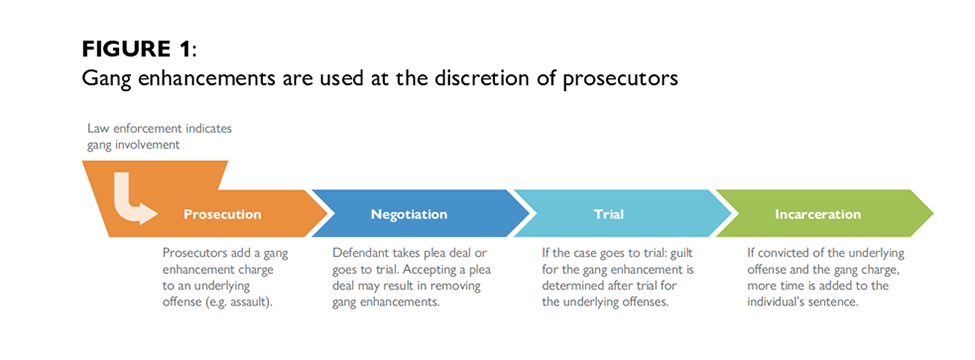
The gang enhancement defines a “criminal street gang” as three or more people who have a common name, sign or symbol, and engage in “a pattern of criminal gang activity.” Prosecutors have complete discretion over whether to add a gang enhancement to a person’s charges based on the evidence in the case
Once a law enforcement officer deems an individual to be part of a gang based on statutory criteria, they are added to the California gang database (CalGang). Individuals must be notified of their addition to the database, and they may submit a written request to contest their inclusion, either by someone over the age of 18 or by a person’s guardian or attorney. Individuals are automatically purged from the database after three years (added as a juvenile) or five years (added as an adult).2 If an individual appears in a gang database, this does not automatically result in gang enhancements being applied to their sentence. The prosecutor may rely upon the person’s appearance in the database, along with other evidence, to make this determination.
To apply a gang enhancement to an individual’s sentence, the prosecution must prove:
- The crime was committed for the benefit of, at the direction of, or in association with a criminal street gang.
- The defendant had the specific intent to promote, further, or assist in criminal conduct by gang members.
If the criteria for the gang enhancement are met, the court can impose additional prison time on top of the sentence for the underlying crime. The severity of the enhancement varies based on the nature of the crime and can range from an additional two years to life in prison, though enhancements over 10 years are rare. The enhancement is 2, 3, or 4 years for most felonies, but is 5 years for “serious” felonies and 10 years for “violent” felonies. A life sentence can be imposed for other specified felonies, including carjacking, home invasion robbery, and shooting at an inhabited house.
Figure 1 illustrates the general process by which gang enhancements are applied to a person’s sentence.
We analyze patterns in the use of gang enhancements for people admitted to the California Department of Corrections and Rehabilitation (CDCR) for the years 2005–2025, before and after the implementation of AB 333. All data and figures in this brief are presented by conviction year. As of the end of May 2026, there were 4,124 people incarcerated with a gang enhancement on their sentence. Of those, 3,436 people were sentenced and admitted to prison before the implementation of AB 333 in January 2022.
Trends in Enhancement Use and Sentence Length
The number of admissions to CDCR with a gang enhancement has declined by 89% since its peak in 2013.
There was a steady decline in total admissions with gang enhancements from 1,241 in 2013 to 139 in 2025 (Figure 2). The pronounced decrease between 2019 and 2020 was likely due to the drop in total CDCR admissions during the pandemic. Following the pandemic, the number of individuals entering CDCR with gang enhancement convictions continued to decline, but at a slower rate. After AB 333 took effect in 2022, the number of gang enhancements continued to slowly decline.
Admissions with a gang enhancement comprise a small and declining share of all CDCR admissions.
The share of CDCR admissions with a gang enhancement declined continuously between its peak in 2014 (3.0%) and 2025 (0.6%), an 80% decline (Figure 3). The steepest drop occurred from 2019–2021, during the COVID-19 pandemic.
The application of gang enhancements declined across all sentence lengths.
The number of total enhancements and the number of individuals receiving those enhancements decreased with similar magnitudes within each sentence length category (Table 1). For instance, the number of individuals receiving two-year gang enhancements decreased by 90% (from 282 in 2013, the highest year, to 29 in 2025), while the number receiving 10-year gang enhancements decreased by 86% (from 337 in 2013 to 46 in 2025). Since 2005, only 61 individuals have received an indeterminate life sentence from a gang enhancement; 85% of these enhancements were applied to murder or attempted murder cases, and all of the offenses associated with these enhancements were for serious or violent felonies.
Gang enhancements can elevate a felony to a “serious” felony, which can impact future sentence length under California’s Three Strikes law. While most sentences receiving a gang enhancement are already serious or violent because of the underlying conviction, any sentence with a gang enhancement is also classified as serious, so in some cases the application of a gang enhancement causes a sentence that would otherwise not be serious to become serious. From 2005–2025, 23% (22% for the more recent period of 2020–2025) of people admitted with a gang enhancement did not have a base sentence with a serious or violent felony, and their sentences did not have any other offense enhancements attached to them other than the gang enhancement. Examples of these types of offenses include vandalism, transporting or selling controlled substances, and vehicle theft.
The use of longer gang enhancements declined more gradually than shorter gang enhancements over the last five years.
The use of 2, 3, and 4-year gang enhancements fell more rapidly during the post-pandemic era, though 5- and 10-year enhancements caught up after sharp decreases in 2025. The share of 10- and 5-year gang enhancements was 42% in 2020 and grew to nearly two-thirds in the 2024 conviction cohort (Figure 4), before decreasing again to 48% of gang enhancements in 2025.
The average time added to an individual’s sentence by gang enhancements has remained stable over the past 20 years.
The average time added was 4.8 years in 2005 and 5.7 years in 2025, with minor fluctuations over time (Figure 5). Sentences for individuals receiving gang enhancements are generally about 10 years longer than the average CDCR sentence length. While this difference spiked to 13 years in 2024 before falling again in 2025, it is difficult to interpret recent-year trends in average sentence length because the number of admissions with gang enhancements is increasingly small. With 200 or fewer people receiving the enhancement in 2024 and in 2025, as few as ten people with differing case characteristics can dramatically affect sentence length averages.
Admissions with gang enhancements result more frequently from jury trials than typical sentences do, but the majority still stem from plea deals.
From 2014–2019, 88% of gang enhancement cases resulted from pleas (as opposed to 12% from trials), compared to 94% of all prison sentences. Over the last five years, however, jury trials resulting in prison sentences with gang enhancements have become less common. From 2020–2025, the plea rate for gang enhancement cases in CDCR custody rose to 93% compared to 95% for all prison sentences. Among CDCR admissions with gang enhancements, there are now fewer than 30 jury trial sentences each year (Figure 6). The plea rate does not vary substantially by race.
Most common offenses and enhancement use by county
Gang enhancements are most commonly applied to various types of assault and other violent crimes; drug crimes are common as well. Gang enhancements have been applied to convictions for over 500 different criminal offenses; Figure 7 presents the top 25 convictions (associated with 83% of all gang enhancements) from 2014–19 and from 2020–25. The underlying offenses to which gang enhancements are added range in severity from vandalism to attempted murder. The most common offenses are assault with force likely to produce great bodily injury, possession or ownership of a firearm by a felon or addict, and voluntary manslaughter. Compared to serious and violent offenses, the use of gang enhancements has decreased more for some non-violent offenses such as burglary (first degree) and possession of a controlled substance for sale.
Gang enhancement use declined across all counties over the past decade, but application rates varied (Figure 8). From 2020–2025, Merced and Tulare counties applied gang enhancements to prison sentences at five to six times the average rate of all counties (as measured by the number of individuals entering CDCR custody with any gang enhancement). The average time added to a prison sentence by gang enhancements also varies by county.
Demographic patterns of enhancement use
Hispanic individuals are overrepresented among those receiving gang enhancements (Figure 9). While Hispanic individuals make up 44% of the CDCR admissions population from 2014–2025, they make up 71% of individuals receiving gang enhancements during this period. This relative disparity persisted through the 2025 conviction cohort.
Racial disparities in the application of gang enhancements vary slightly across counties (Figure 10), but all counties have racial disparities. In Sacramento County, for instance, Black individuals are overrepresented amongst people receiving gang enhancements (64% of gang enhancement admissions vs. 44% of general admissions), while Hispanic individuals are underrepresented (20% vs 22%). By contrast, Black individuals are underrepresented in Santa Clara (7% of gang enhancement admissions vs. 13% of general admissions), while Hispanic individuals are overrepresented (85% vs. 61%). In many counties, such as Los Angeles, San Bernardino, Contra Costa, and others, both Hispanic and Black individuals are overrepresented amongst people receiving gang enhancements. In all counties, White individuals are underrepresented amongst people receiving gang enhancements compared to the share of White individuals in the general admission population.
Young people aged 18–25 at the time of their offense comprise 70.5% of admissions with gang enhancements (Figure 11). This same age group represents only 30% of CDCR admissions in the general population. In other words, the proportion of gang enhancements applied to young people is more than double their proportion in the prison population.
This age overrepresentation is not present for White individuals and is especially pronounced among young Hispanic individuals. Nearly half (50.7%) of all individuals who received a gang enhancement from 2014–2025 were Hispanic youth aged 18 to 25 (Figure 12). Of the small number of White individuals who receive gang enhancements, 48% are 25 years old or younger, compared to 70% of Black and Hispanic individuals who receive gang enhancements. Over 96% of individuals receiving gang enhancements are men (compared to 92% of the general CDCR admission population during this time), so young Hispanic and Black men receive the overwhelming majority of gang enhancements.
Conclusion
The number of prison admissions that include gang enhancements has declined dramatically since peaking in 2013, with the total number of annual admissions dropping by 89% and their share of all prison admissions falling from 3% to 0.6% by 2025. Since the implementation of AB 333 in 2022 — which narrowed the legal definition of a “criminal street gang” — the use of these enhancements has continued to decline. Despite the overall reduction in use, stark demographic disparities remain: Hispanic individuals and transition-aged youth — specifically young Hispanic men — continue to be significantly overrepresented among those receiving gang enhancements compared to their share of the general prison population. Variation across counties in the rate of gang enhancement use persists as well, with Merced and Tulare adding gang enhancements to prison sentences at the highest rate from 2020–2025.
About this research
This research stems from a partnership between the California Policy Lab at the University of California and the Committee on Revision of the Penal Code, a state agency that studies and makes recommendations to improve California’s criminal justice system.
Acknowledgements
Support for this research was generously provided by the California Committee on Revision of the Penal Code. The views expressed are those of the authors and do not necessarily reflect the views of our funders. All errors should be attributed to the authors.
Suggested Citation: Sloan, T., Lacoe, J., Yang, E. (2026). Trends in California’s Application of Gang Enhancements. California Policy Lab, University of California. https://capolicylab.org/trends-in-californias-application-of-gang-enhancements/
ENDNOTES
- Unless otherwise specified, years shown in charts and tables refer to the year of conviction as opposed to the admission year in CDCR. ↩︎
- Department of Justice Regulations for the Fair and Accurate Governance of the CalGang Database, 11 Cal. Code Regs. § 750 (2020) https://oag.ca.gov/sites/all/files/agweb/pdfs/bciis/ch7-5-proposed-text.pdf: CalGang® Frequently Asked Questions (FAQs). State of California Department of Justice – Office of the Attorney General. https://oag.ca.gov/calgang/faqs. ↩︎